

How Long Has The Us Used Animals For Testing History Of Makeup Testing On Animals

Source: Ben Goldacre, "Animal Enquiry Written report Shows Many Tests Are Full of Flaws," theguardian.com, Jan. 22, 2010
An estimated 26 meg animals are used every yr in the United states of america for scientific and commercial testing. [two] Animals are used to develop medical treatments, determine the toxicity of medications, check the safety of products destined for homo utilise, and other biomedical, commercial, and health intendance uses. Enquiry on living animals has been skilful since at least 500 BC.
Proponents of beast testing say that it has enabled the development of numerous life-saving treatments for both humans and animals, that there is no culling method for researching a complete living organism, and that strict regulations prevent the mistreatment of animals in laboratories.
Opponents of animal testing say that it is cruel and inhumane to experiment on animals, that alternative methods available to researchers tin can replace animal testing, and that animals are and then unlike from human beings that research on animals frequently yields irrelevant results.
Regulations
Animal testing in the United States is regulated by the federal Animate being Welfare Deed (AWA), passed in 1966 and amended in 1970, 1976, and 1985. [27] The AWA defines "animal" every bit "any alive or dead domestic dog, cat, monkey (nonhuman primate mammal), guinea squealer, hamster, rabbit, or such other warm blooded animate being." The AWA excludes birds, rats and mice bred for research, common cold-blooded animals, and farm animals used for food and other purposes. [3]
The AWA requires that each research facility develop an internal Institutional Animal Committee (more commonly known as an Institutional Animal Care and Utilise Commission, or IACUC) to "represent order's concerns regarding the welfare of animate being subjects." The Commission must exist comprised of at least three members. I fellow member must be a veterinarian and i must be unaffiliated with the institution.
While the AWA regulates the housing and transportation of animals used for research, it does not regulate the experiments themselves. The US Congress Conference Commission stated at the time of the bill'south passage that information technology wanted "to provide protection for the researcher… by exempting from regulations all animals during actual research and experimentation… It is not the intention of the committee to interfere in whatsoever way with research or experimentation." [66]
Animal studies funded by US Public Health Service (PHS) agencies, including the National Institutes of Health (NIH), are further regulated by the Public Wellness Service Policy on Humane Care and Utilise of Laboratory Animals. [27] All PHS funded institutions must base of operations their animal care standards on the AWA and the Guide for the Intendance and Use of Laboratory Animals (also known as "the Guide"), prepared by the Constitute for Laboratory Animal Enquiry at the National Research Council. Unlike the AWA, the Policy on Humane Care and Use of Laboratory Animals and the Guide embrace all vertebrate animals used for enquiry, including birds, rats and mice. The Guide "establishes the minimum ethical, practice, and care standards for researchers and their institutions," including environs and housing standards and required veterinary care. The Guide stipulates that "the avoidance or minimization of discomfort, distress, and pain when consequent with sound scientific practices, is imperative." [71]

Source: wikipedia.org (accessed October. 22, 2013)
The US Department of Agriculture (USDA) Animal and Plant Health Inspection Service (APHIS) reports the number of animals used for research each year, though it excludes animals not covered past the AWA. For fiscal year 2010 (the latest year for which data are available as of Oct. 11, 2013), 1,134,693 animals were reported. [26] Since the data excludes cold-blooded animals, farm animals used for food, and birds, rats, and mice bred for utilize in inquiry, the total number of animals used for testing is unknown. Estimates of the number of animals non counted by APHIS range from 85%-96% of the full of all animals used for testing. [2][65][72][one]
The USDA breaks down its data by 3 categories of pain blazon: animals that experience hurting during their use in research but are given drugs to alleviate it (339,769 animals in 2010); animals who feel pain and are not given drugs (97,123); and animals who do not experience hurting and are not given drugs (697,801). [26]
The US Food and Drug Assistants, which regulates the evolution of new medications, states that "At the preclinical stage, the FDA volition generally ask, at a minimum, that sponsors… make up one's mind the acute toxicity of the drug in at to the lowest degree two species of animals." [73]
Public Opinion
A public outcry over animate being testing and the treatment of animals in general bankrupt out in the United States in the mid-1960s, leading to the passage of the AWA. An article in the November 29, 1965 issue of Sports Illustrated about Pepper, a farmer's pet Dalmation that was kidnapped and sold into experimentation, is believed to have been the initial catalyst for the rise in anti-testing sentiment. [74] Pepper died afterwards researchers attempted to implant an experimental cardiac pacemaker in her torso. [75]
A May 2013 Gallup poll found that 56% of Americans say medical testing on animals is morally adequate (downwardly from 65% in 2001), with 39% saying it is morally wrong. [76] Younger Americans are less likely to take animal testing. 47% of people aged eighteen-34 say that animal testing is morally acceptable, whereas 60% of people aged 35-54 and 61% of people anile 55 and older say it is morally acceptable. [77] 67% of registered voters in the Us are opposed to using animals to test cosmetics and personal care products, according to a 2013 nationwide poll conducted by Lake Research Partners. The poll found that women are more likely to object, with 76% of women under 50 and 70% of women over l being opposed to animal testing, and 63% of men nether and over 50 being opposed. 52% of voters said they experience safer using a product that was tested using non-brute methods, while 18% said they feel safer with products tested on animals. [78]
Early on History
Descriptions of the autopsy of alive animals have been found in ancient Greek writings from as early as circa 500 BC. Medico-scientists such as Aristotle, Herophilus, and Erasistratus performed the experiments to notice the functions of living organisms. [79][80] Vivisection (autopsy of a living organism) was practiced on human being criminals in aboriginal Rome and Alexandria, simply prohibitions confronting mutilation of the human body in ancient Hellenic republic led to a reliance on animal subjects. Aristotle believed that animals lacked intelligence, then the notions of justice and injustice did not apply to them. Theophrastus, a successor to Aristotle, disagreed, objecting to the vivisection of animals on the grounds that, like humans, they tin can feel pain, and causing pain to animals was an barb to the gods. [eighty]
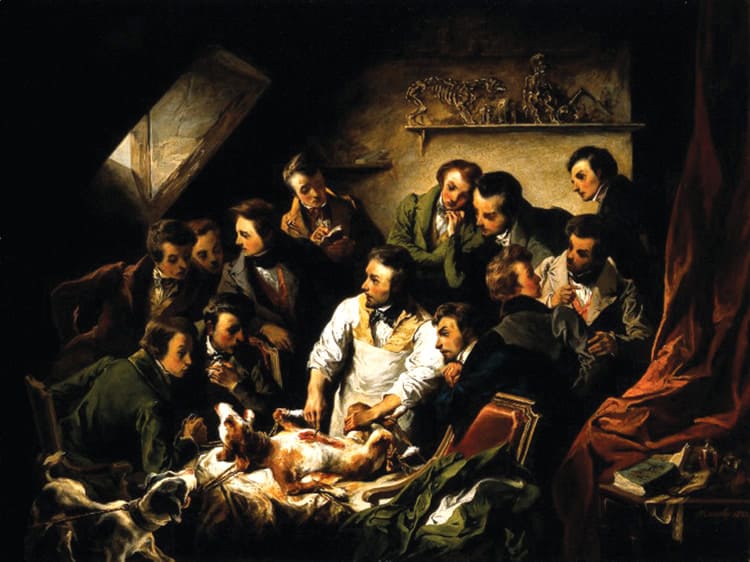
Source: Lindsey Nield, "History: The Nature of the Fauna," bluesci.org, Jan. four, 2010
Roman physician and philosopher Galen (130-200 Advertisement), whose theories of medicine were influential throughout Europe for fifteen centuries, engaged in the public dissection of animals (including an elephant), which was a pop course of entertainment at the time. [81][80] Galen besides engaged in creature vivisection in society to develop theories on human anatomy, physiology, pathology, and pharmacology. [82] In one of his experiments, he demonstrated that arteries, which were believed by earlier physicians to contain air, actually contained blood. Galen believed that animal physiology was very similar to that of man beings, simply despite this similarity he had little sympathy for the animals on which he experimented. Galen recommended that his students vivisect animals "without pity or pity" and warned that the "unpleasing expression of the ape when information technology is being vivisected" was to be expected. [80]
French philosopher René Descartes (1596-1650), who occasionally experimented on alive animals, including at least one rabbit, likewise as eels and fish, believed that animals were "automata" who could not experience pain or suffer the way that humans practise. [66] Descartes recognized that animals could feel, just because they could not think, he argued, they were unable to consciously experience those feelings. [83]
English Physician William Harvey (1578-1657) discovered that the heart, and not the lungs, circulated blood throughout the body every bit a result of his experiments on living animals. [84][85]
Animal Testing in the 1800s and Early 1900s
There was little public objection to animal experimentation until the 19th Century, when the increased adoption of domestic pets fueled interest in an anti-vivisection motion, primarily in England. This tendency culminated in the founding of the Society for the Protection of Animals Liable to Vivisection in 1875, followed by the formation of similar groups. [79][87]
I of the showtime proponents of fauna testing to respond to the growing anti-testing movement was French physiologist Claude Bernard in his Introduction to the Study of Experimental Medicine (1865). Bernard argued that experimenting on animals was ethical considering of the benefits to medicine and the extension of human being life. [79]
Queen Victoria was an early opponent of animal testing in England, according to a alphabetic character written past her private secretary in 1875: "The Queen has been dreadfully shocked at the details of some of these [animal research] practices, and is almost anxious to put a stop to them." [88] Shortly the anti-vivisection campaign became strong plenty to pressure lawmakers into establishing the first laws controlling the employ of animals for research: Smashing Britain's Cruelty to Animals Human action of 1876. [fifteen]
Russian physiologist Ivan Pavlov (1849-1936) demonstrated the "conditioned reflex" by training dogs to salivate upon hearing the sound of a bell or electric buzzer. In order to measure out "the intensity of the salivary reflex," wrote Pavlov, the dogs were subjected to a "minor operation, which consists in the transplantation of the opening of the salivary duct from its natural place on the mucous membrane of the mouth to the outside skin." A "small drinking glass funnel" was then attached to the salivary duct opening with a "special cement." [86][75]

Source: thedailytouch.com, Mar. xx, 2013
In 1959, The Principles of Humane Experimental Technique past zoologist William Russell and microbiologist Rex Burch was published in England. The book laid out the principle of the "Three Rs" for using animals in enquiry humanely: Replacement (replacing the use of animals with culling research methods), Reduction (minimizing the employ of animals whenever possible), and Refinement (reducing suffering and improving animals' living conditions). [89] The "3 Rs" were incorporated into the AWA and have formed the basis of many international animal welfare laws. [90][91]
Animals in Space and the Military
Since every bit early equally 1948, animals have been used past the Usa space programme for testing such aspects of space travel as the effects of prolonged weightlessness. After several monkeys died in unmanned infinite flights carried out during the 1940s, the first monkey to survive a space flight was Yorick, recovered from an Aerobee missile flight on Sep. 20, 1951. However, Yorick died several hours after landing, perchance due to heat stress. [vii][116] The get-go living creature to orbit the Earth was Laika, a stray dog sent into infinite on the Soviet spacecraft Sputnik 2 in Nov. 1957. Laika died of "overheating and panic" early on in the mission, co-ordinate to the BBC. [92] The record for the most animals sent into space was set Apr. 17, 1998, when more than two thousand animals, including rats, mice, fish, crickets, and snails, were launched into infinite on the shuttle Columbia (along with the seven-member human being crew) for neurological testing. [vii][viii]
Since the Vietnam war, animals have also been used by the US military. The US Section of Defense used 488,237 animals for research and combat trauma grooming ("alive tissue training") in fiscal year 2007 (the latest twelvemonth for which data are bachelor), which included subjecting anesthetized goats and pigs to gunshot wounds, burns, and amputations for the training of military machine medics. [6][93] In Feb 2013, after an escalation of opposition by creature rights groups such as People for the Ethical Treatments of Animals (PETA), Congress ordered the Pentagon to present a written plan to phase out alive tissue preparation. The U.s.a. Coast Baby-sit, however, which was at the center of a 2012 scandal involving videotaped footage of goats existence mutilated every bit office of its live tissue grooming program, said in May 2013 that the plan will go on. [94][95]
The Modern Argue
The 1975 publication of Fauna Liberation by Australian philosopher Peter Singer galvanized the animate being rights and anti-testing movements by popularizing the notion of "speciesism" as existence analogous to racism, sexism, and other forms of prejudice. Addressing animal testing specifically, Vocaliser predicted that "i solar day… our children's children, reading about what was done in laboratories in the twentieth century, will feel the aforementioned sense of horror and incredulity… that we at present experience when we read nearly the atrocities of the Roman gladiatorial arenas or the eighteenth-century slave trade." [66]
In 1981, an early victory by so-fledgling animal rights group People for the Ethical Treatment of Animals (PETA) served to revitalize the anti-testing move once again. A PETA activist working cloak-and-dagger at the Institute for Biological Research in Silver Spring, MD took photographs of monkeys in the facility that had engaged in self-mutilation due to stress. The laboratory'southward director, Edward Taub, was charged with more than a dozen animal cruelty offences, and an peculiarly notorious photograph of a monkey in a harness with all iv limbs restrained became a symbolic image for the animal rights move. [96]
In 2001, controversy erupted over fauna experiments undertaken by a veterinarian at Ohio State University. Dr. Michael Podell infected cats with the feline AIDS virus in order to written report why methamphetamine users deteriorate more quickly from the symptoms of AIDS. After receiving several decease threats, Dr. Podell abandoned his academic career. [97] Over 60% of biomedical scientists polled by Nature magazine say "animal-rights activists present a real threat to essential biomedical research." [35]
A 2007 report by the National Research Council of the National Academy of Sciences called for a reduction in the use of beast testing, recommending instead the increased use of in vitro methods using human cells. Though the report touted new technologies that could eventually eliminate the demand for fauna testing altogether, the authors acknowledged that "For the foreseeable hereafter… targeted tests in animals would demand to be used to complement the in vitro tests, because current methods cannot yet fairly mirror the metabolism of a whole animate being." [104]
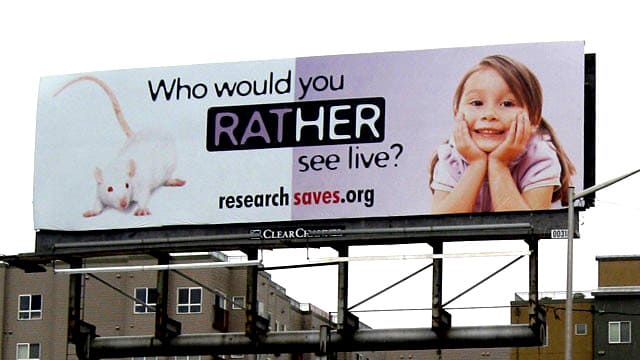
Source: Jane E. Allen, "Animal Rights: Scientists' Billboards Ask Whether You'd Relieve a Child or a Lab Rat," abcnews.go.com, Apr. xiv, 2011
In Mar. 2013, the European Union banned the import and sale of cosmetic products that employ ingredients tested on animals. Some proponents of creature testing objected, arguing that some animal tests had no non-animal equivalents. A spokesman for the trade association Cosmetics Europe stated it is likely "that consumers in Europe won't take access to new products considering nosotros can't ensure that some ingredients will be safety without admission to suitable and adequate testing." [98] India and Israel have besides banned animal testing for corrective products, while the United states has no such ban in identify. [99]
China is the only major market where testing all cosmetics on animals is required by law, and strange companies distributing their products to China must also have them tested on animals. [65][43] Communist china has announced that its creature testing requirement will be waived for shampoo, perfume, and other then-called "non-special employ cosmetics" manufactured by Chinese companies after June 2014. "Special utilise cosmetics," including pilus regrowth, hair removal, dye and permanent wave products, antiperspirant, and sunscreen, volition go on to warrant mandatory animal testing. [114] Cathay'southward National Medical Products Administration announced that animate being testing for "ordinary" cosmetics (those that do non make claims such equally "anti-aging") will no longer be required as of May 2021. [149]
Afterward ceasing to breed chimpanzees for research in May 2007, the U.s. National Institutes of Health announced in June 2013 that it would retire most of its chimpanzees (310 in full) over the adjacent several years. While the decision was welcomed past animate being rights groups, opponents said the conclusion would accept a negative touch on on the development of disquisitional vaccines and treatments. The Texas Biomedical Inquiry Institute released a statement claiming that the number of chimps to be retained (upward to 50) was "not sufficient to enable the rapid development of better preventions and cures for hepatitis B and C, which kill a million people every year." [100] On November. 18, 2015 the U.s. National Institutes of Health appear that its remaining 50 research chimpanzees will be retired to the Federal Chimpanzee Sanctuary System. [117] Gabon remains the only country in the world that still experiments on chimpanzees. [iv]
The Environmental Protection Agency (EPA) released a plan on Sep. 10, 2019 to reduce studies using mammal testing by thirty% by 2025 and to eliminate the mammal testing altogether by 2035. [131] In Nov. 2019, the FDA enacted a policy assuasive some lab animals used for animal testing to be sent to shelters and sanctuaries for adoption. The National Institutes of Wellness (NIH) adopted a like policy in Aug. 2019 and the Department of Veterans Affairs (VA) did so in 2018. [146]
On Sep. ii, 2021, Mexico became the 41st country and first in Due north America to ban cosmetics testing on animals, co-ordinate to the Humane Order International. [150]
Animal Testing and COVID-xix
The COVID-19 (coronavirus) global pandemic brought attention to the argue about animal testing as researchers sought to develop a vaccine for the virus equally chop-chop as possible. Vaccines are traditionally tested on animals to ensure their safety and effectiveness. News broke in Mar. 2020 that there was a shortage of the genetically modified mice that were needed to test coronavirus vaccines. [133]
Meanwhile, other companies tried new development techniques that allowed them to skip animal testing and start with man trials. Moderna Therapeutics used a synthetic copy of the virus genetic lawmaking instead of a weakened form of the virus. [143] The FDA approved an application for Moderna to begin clinical trials on a coronavirus vaccine on Mar. four, 2020, and the first participant was dosed on Mar. 16, 2020. [147]
A shortage of monkeys, including pinkish-faced rhesus macaques, threatened vaccine development at the beginning of the pandemic and as variants of COVID-19 were found. The monkeys were previously flown in from Cathay, but a ban on wildlife imports from Mainland china forced researchers to look elsewhere, a difficult task as Cathay previously supplied over threescore% of research monkeys in the United States. [148]
| More than Creature Pros and Cons |
|---|
| Should zoos exist? Proponents say zoos educate the public about animals. Opponents say wild animals should never be kept captive. |
| Should One thousand-12 students dissect animals in science classrooms? Proponents say dissecting real animals is a amend learning experience. Opponents say the practise is bad for the surround. |
| Is CBD practiced for pets? Proponents say CBD is helpful for pets' feet and other conditions. Opponents say the products aren't regulated. |
Source: https://animal-testing.procon.org/history-of-animal-testing/
Posted by: villatoroliefalmid1964.blogspot.com
0 Response to "How Long Has The Us Used Animals For Testing History Of Makeup Testing On Animals"
Post a Comment