

What Is The "Demographic" Makeup Of The Nfib
The American economy is experiencing the slowest recovery in 70 years. In addition to persistently high unemployment, labor force participation has fallen sharply since the recession began in December 2007. Today, v.7 million fewer Americans are working or looking for work. This drop accounts for nigh the entire reduction of the unemployment rate since 2009—those not looking for piece of work do not count as unemployed.
Demographic changes explain approximately one-quarter of the driblet in labor force participation. The baby boomers are crumbling and thus more likely to retire, dropping out of the labor force. The remaining drop in participation primarily comes from millions more people going on inability insurance or attending school. While those enrolled in schoolhouse will probably return to the labor force, those going on the inability rolls will not. They will remain permanently outside the labor force.
The difficulty of finding a chore drives both these changes. Job creation savage sharply after the recession began, and—unlike layoffs—has not recovered. The government's responses have been largely ineffective. Instead of voting for vast subsidies and public works programs, Congress should reduce the taxation and regulatory brunt it imposes on businesses to encourage hiring and end the fall in labor forcefulness participation.
The Slow Recovery
The collapse of the housing bubble and the resulting financial crisis sent the U.South. economy into a recession in December 2007. Recessions and financial crises are non unusual occurrences. The savings and loan crisis and the Volcker disinflation contributed to the recessions of the early 1990s and 1980s, respectively. The recovery from both these recessions was potent. What is unusual well-nigh today'southward economy is how slowly it has recovered.
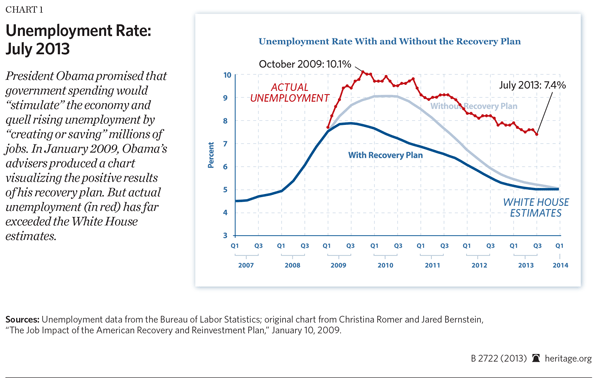
Officially, the current recession ended in June 2009—the month that, despite a 9.5 per centum unemployment rate, marked the end of the concluding quarter of the GDP contraction that began in 2008. When President Barack Obama took role in early on 2009, his Administration projected that if Congress passed his stimulus bundle, unemployment would fall from vii.eight per centum at that time to 5 pct by mid-2013. The Assistants warned that if Congress did non pass the stimulus package, unemployment would run 1.five to ii pct points higher in 2010 and 2011. Congress passed the stimulus, still unemployment rose to 10 percent in Oct 2009, and did non fall below 8 percent until late 2010. Total employment in the economy remains 1.5 per centum below the pre-recession top of 138 meg workers.[1]
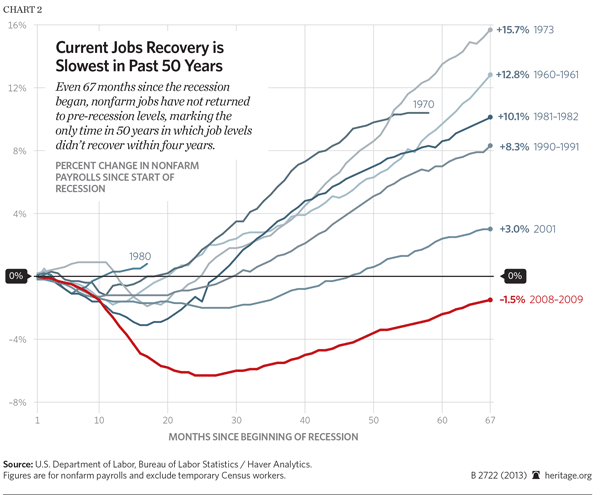
This represents the slowest recovery in the postwar era. Subsequently every other recession, the economy fully replaced the lost (net) employment within ii to iv years of the recession'southward onset. Investors and entrepreneurs chop-chop found productive new uses for the millions of idled workers and billions in idle majuscule. Not since the Great Depression has employment remained beneath its pre-recession levels four and a half years after a downturn started.
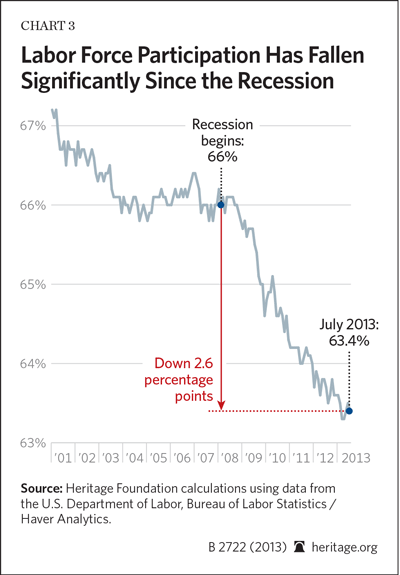
Lower Participation = Lower Unemployment Rate. As high equally the unemployment numbers are, they all the same enlarge the economic system's performance. Since the recession began, the labor force participation rate—the proportion of adults either working or trying to notice piece of work—has fallen by 2.6 percent points. The government counts only people actively looking for jobs equally unemployed. The drop in labor forcefulness participation accounts for virtually the entire cyberspace drib in the unemployment rate over the past three years.
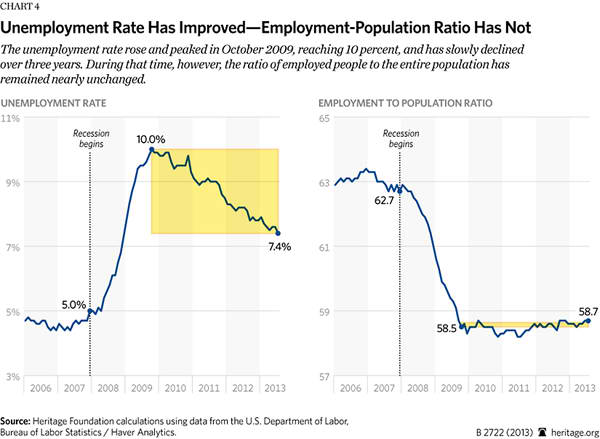
Some other mensurate of the state of the labor market is the employment-population ratio. This ratio shows employees as a proportion of all adults, both those looking for work and those outside the labor force. During the recession, the employment-population ratio vicious sharply and the unemployment rate increased. Since then, the unemployment rate has improved modestly. The employment-population ratio has not.
The unemployment rate peaked at ten.0 percent in October 2009 and currently stands at 7.4 pct. The employment-population ratio has gone from 58.5 percentage to 58.7 percent during this time. Unemployment has fallen because fewer Americans are looking for work, not because more than Americans are finding jobs. Task creation since the recession concluded has only been enough to keep pace with population growth.
A Smaller Labor Strength—What Information technology Means
Understanding why labor force participation has fallen is critically important for assessing the state of the economic system. When millions of people would like to exist employed, but have given upward on finding work, the official unemployment rate understates the weakness of the labor marketplace. It omits millions of potential workers who have go so discouraged they have stopped job searching.
On the other paw, economists are expecting labor force participation to fall no matter what happens in the labor market. The starting time of the baby boomers turned 65 in 2011. People in their 60s are considerably less probable to work and more probable to retire than those in their 50s. An aging population will button down labor force participation whether the economy does well or poorly. The aging of the baby boomers presents economic challenges for America, but these challenges accept naught to do with the cyclical country of the economic system. If demographic changes explicate most of the drop in labor force participation, so the unemployment charge per unit accurately measures the wellness of the economic system.
Examining the Drop in Employment. The Bureau of Labor Statistics (BLS) surveys a representative sample of tens of thousands of households each month. The BLS reports the proportion of Americans who are employed, unemployed, and non in the labor force. People outside the labor force do many things: enjoy their retirement, study in schoolhouse, collect disability benefits, take intendance of family members, or fight illness.[2] The BLS asks individuals outside the labor force what they are doing, merely does not regularly written report these details.
The Heritage Foundation analyzed micro-data from the BLS's Current Population Survey to break down the changes in employment, unemployment, and those exterior the labor forcefulness. Table one shows the alter in these figures between 2007 (the last twelvemonth earlier the recession) and 2012 (the most recent full year in the recovery).[3] Tabular array 1 also shows how those figures would be different if the employment, unemployment, and not in labor force rates had remained constant between 2007 and 2012.[four]
Between 2007 and 2012 the employment-population ratio fell by four.4 percentage points, while the unemployment-population ratio increased by ii.1 percentage points and the labor force participation charge per unit fell by two.3 percentage points.[5] Had employment and unemployment remained at their previous rates, 10.viii meg more than Americans would have jobs: 5.i one thousand thousand fewer unemployed Americans and 5.7 million more Americans participating in the labor force.
Three categories explain the majority of the subtract in labor force participation. The proportion of those exterior the labor strength and attending school has risen by 0.9 percentage (two.1 million), the proportion collecting disability insurance has risen by 0.7 percent (1.eight million), and the proportion of retirees increased by 0.eight per centum (i.9 million). At that place were minor changes in the proportion of those outside the labor force and spending fourth dimension with family (–0.2 percent), while the proportion of those not working due to disease or exterior the labor force for "other" reasons did not change.
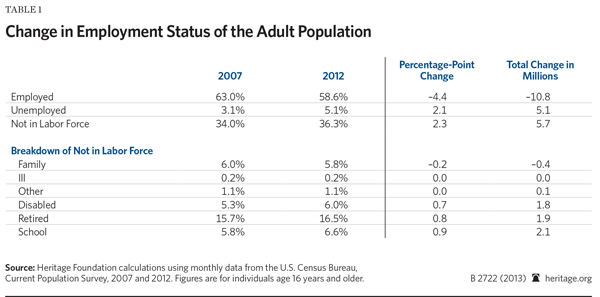
These figures practise not reveal what portion of these changes demographic changes caused and what portion the recession caused. The aging of the baby boomers should naturally cause more Americans to retire, pushing downward labor forcefulness participation. Conversely, the generation of workers currently retiring has less education than the generations succeeding them. More educated workers accept college labor force participation rates. Ascension education levels will increase labor force participation.
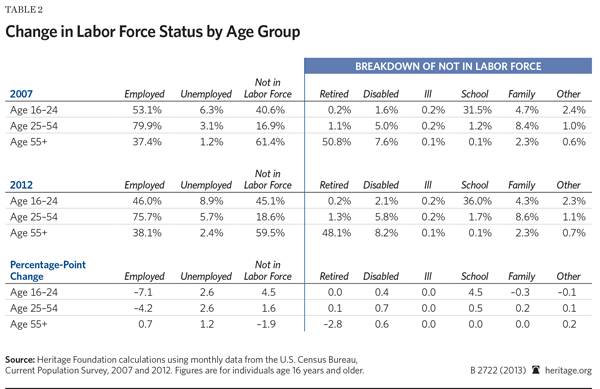
Change in Labor Force Condition past Age. Table 2 shows the change in the employment status of the adult population by age and education categories. The recession has not affected everyone equally. Workers aged 16 to 24 experienced the largest drop in employment (–7.1 pct points) and the largest increment in those exterior the labor force (+4.5 percentage points). Conversely, the employment rate of workers 55 and older increased noticeably (+0.7 percentage point) and the proportion of those 55 and older outside the labor force brutal by 1.9 percentage points.
The latter change is driven by a sharp decrease in retirement rates (–ii.8 percentage points). Older Americans are less likely to retire now than before the recession began. However, workers 55 and older are yet more likely to be outside the labor force (usually retired) than whatsoever other age group. Consequently, the crumbling of the population has increased the number of retirees even every bit the retirement rate has fallen.
The increase in inability insurance varies only slightly by age group. Workers in all age groups were between 0.4 and 0.vii per centum point more likely to be on Disability Insurance in 2012. The same is not truthful of schooling. The largest increase in those outside the labor force and attending school—unsurprisingly—came amongst younger workers (+4.5 percentage points).
This does non necessarily mean that younger Americans are more probable to enroll in school. The "employed" and "not in the labor force–in schoolhouse" categories are mutually exclusive. It could too exist that students who in the past would have had office-time jobs now cannot find work. Thus, they are classified as outside the labor strength. These figures prove how the activities of those outside the labor forcefulness accept changed. They do non bear witness whether those outside the labor strength and in schoolhouse would have jobs if they could get them.
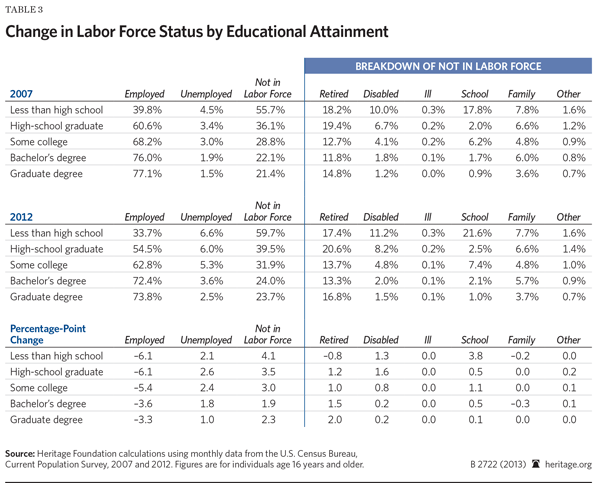
Change in Labor Forcefulness Status by Instruction. Tabular array iii shows how the labor force status has inverse by educational attainment.[6] Fifty-fifty before the recession those with more pedagogy were more attached to the labor force and had lower unemployment rates. The burden of the recession has fallen heaviest on those with less education. The employment rates of those with less than a high school caste and high school graduates have fallen the most (–six.1 percentage points). These groups also have the largest decreases in labor force participation (4.ane percentage points and iii.5 percentage points, respectively). Workers with bachelor'southward degrees saw considerably smaller (–3.vi percentage points) decreases in their employment rates and labor force participation rates (1.ix percentage points).
A substantial role of the drib in labor force participation for workers without a loftier schoolhouse caste comes from those enrolled in schoolhouse (+3.viii percentage points). Many of these individuals are younger Americans studying in high schoolhouse. The recession has encouraged many of them to proceed their pedagogy—it volition be difficult for them to find a job if they drop out. Similarly, difficulty finding part-time jobs has caused many students to drop out of the labor forcefulness, though they remain in school.
Table iii also shows notable differences in disability insurance claims. The increment in workers dropping out of the labor strength and going on disability insurance was greatest for workers with at about a high school degree (+i.6 per centum points) or who take not finished high school (+1.iii percentage). Workers with a bachelor'south degree or a graduate degree were considerably less likely to increase their utilise of inability insurance (+0.2 percent point).
Property Demographics Constant. Tables 2 and three demonstrate the importance of controlling for demographic factors before drawing conclusions about the economy. An older or more educated workforce will accept a unlike zipper to the labor strength than a younger, less educated workforce. One way to control for demographic changes is to calculate what the employment condition of the overall population would look like if the age–sex activity–education distribution of the population did non modify only the employment condition of each separate age–sex–education grouping changed equally it really did.[seven] This hypothetical employment status shows what the unemployment rate would have been if demographics remained unchanged since 2007.
Table 4 shows the actual and hypothetical change in the employment status of the developed population. The employment-population ratio roughshod by iv.4 percentage points, of which 4.0 pct points remain afterward controlling for demographics. Similarly, 1.7 percent points (4.2 1000000 people) of the ii.3 percent point (5.vii million people) decrease in labor force participation remains afterward controlling for demographic factors. Approximately 1-quarter of the drop in labor forcefulness participation is due to demographic—not strictly economic—factors. The Federal Reserve Bank of Chicago has come up to the aforementioned conclusion, finding that demographic factors deemed for i-quarter of the drop in labor force participation between 2008 and 2011.[eight]
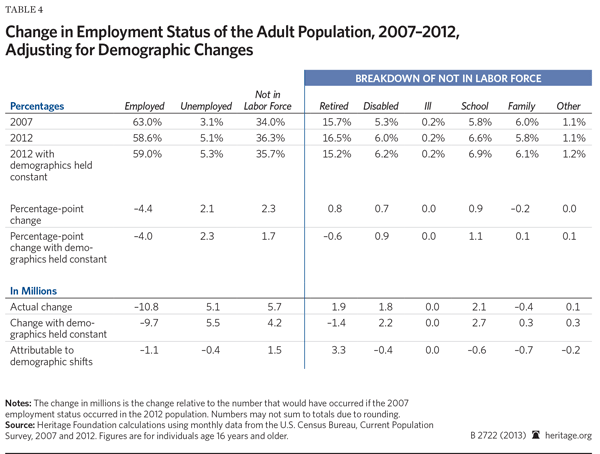
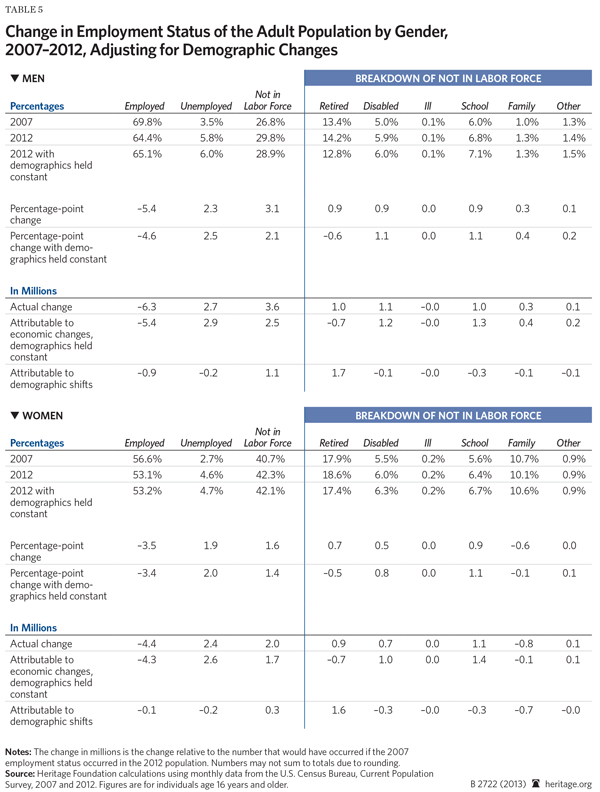
Later on accounting for demographics, 3 major categories of workers outside the labor forcefulness inverse significantly between 2007 and 2012.[9] The increase in retirements decreased the labor force participation charge per unit by 0.viii percent point.[10] That increase was due entirely to the aging population. Older workers have become much less likely to retire since 2007. If America'south demographic makeup had not changed between 2007 and 2012, lower retirement rates would take increased the labor forcefulness participation charge per unit by 0.half-dozen percentage points.
Controlling for demographics also increases the number of those who are outside the labor force and attention schoolhouse. The demographics-adjusted increment rises from 0.ix pct point (ii.ane million people) to 1.1 pct points (two.vii one thousand thousand people). The aging population means that fewer people are likely to be enrolled in school. Controlling for this, the increase in those non participating in the labor force and enrolled in school becomes even more pronounced.
A similar miracle explains the demographics-adjusted increase in inability insurance recipients. Overall the proportion of workers claiming disability insurance increased by 0.seven percentage point—1.viii million more people. Still, more educated workers are less probable to collect inability insurance than workers with lower levels of didactics. (Run across Tabular array 3.) As older workers leave the labor force, they are being replaced by workers who are, on average, ameliorate educated than they are. This tendency should reduce disability claims. Had the population not go more educated, disability claims would have risen by 0.9 percentage point (2.2 million workers). Decision-making for demographic changes makes the recent increase in inability insurance even more pronounced.
Each of these factors—disability claims, schooling, and retirement—reflects weakness in the labor market.
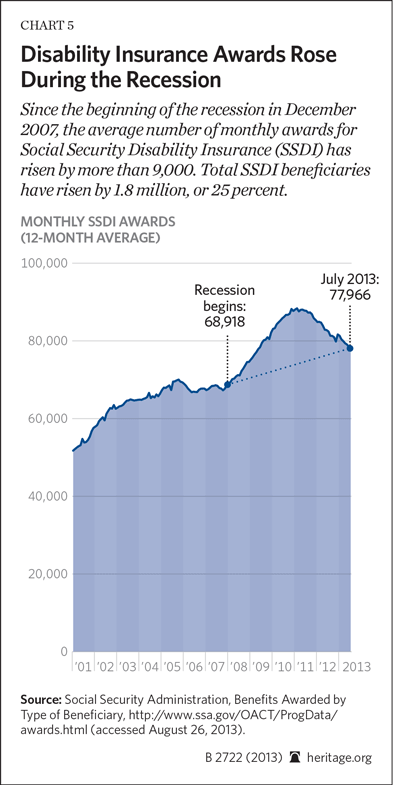
Disability Insurance Claims Rising. The Current Population Survey data showing rising disability claims tracks closely with Social Security Assistants (SSA) information. SSA information shows the number of workers applying for SSDI benefits has been increasing, and that increment has accelerated in the recession. Past the terminate of 2001, the SSA paid out inability benefits to v.3 million workers and granted disability condition to an average of 57,600 people per month.[11] Past December 2007, those figures had grown to 7.i one thousand thousand workers collecting SSDI and an average of 68,900 new inability benefits awards per month. During the recession, SSDI use has increased fifty-fifty more rapidly. By July 2013, fully eight.9 million workers were collecting disability benefits and an average of 77,966 new beneficiaries were joining each month.[12] Over the past decade, the number of workers collecting disability insurance has risen by three.1 million—55 percentage points.
Americans take not go sicker over the past 10 years. Surveys show that Americans' wellness has improved. Mortality rates accept fallen, too. Advances in medical technology allow most Americans to alive healthier and better lives.[13] Nonetheless, disability insurance claims keep to ascension.
Studies show that a significant number of workers who apply for disability benefits are not entirely disabled. They have medical weather that qualify them for benefits, but under other circumstances they could work at some type of task. Given the option of receiving benefits, however, they have them.[14] The upshot is especially pronounced for lower-income workers, who are much more probable to be afflicted by a difficult job market place: SSDI benefits represent a significantly larger proportion of their potential earnings. In a recession, layoffs increase—particularly among less skilled workers—and finding piece of work becomes particularly hard. This leads many workers who lose their jobs to apply for disability benefits instead.
Unfortunately, very few of these workers will e'er render to the labor force. The overwhelming majority of people who exit the disability insurance programme exercise so because they either authorize for Social Security retirement benefits (52 percent) or because they dice (37 percent). But ten pct of SSDI beneficiaries who leave the system do so because their health has improved plenty so that they no longer qualify for benefits.[xv] Even fewer workers voluntarily get out inability insurance to piece of work. Congress created the "Ticket-to-Work" program in 1999, which allowed SSDI beneficiaries to render to work while keeping their wellness coverage. Over the next seven years, fewer than i,400 claimants used the plan to return to work.[16]
The decrease in labor force participation as workers employ for inability benefits is probably permanent. In addition to hurting the economy, this decrease adds to the severe strain on Social Security's finances. The government currently spends $140 billion a year on Disability Insurance payments—more than one of every six Social Security dollars—and pays tens of billions more for health benefits for SSDI beneficiaries.[17] The Social Security Disability Insurance trust fund is now rapidly running out of money. The fund'southward trustees expect information technology to exist wearied in three years.[18]
School Enrollment. The proportion of workers who are outside the labor force and enrolled in school has besides risen sharply in the recession. Together, the increase in individuals enrolled in school and the increment in workers collecting inability benefits account for nearly all of the non-demographic subtract in labor force participation. Like disability insurance, this reflects the weakness of the labor market—particularly for younger workers.
The recession hit younger people particularly hard. Hiring fell sharply, and there are now fewer task openings. Immature people face competition from more experienced workers for existing openings. As Table 2 shows, employment has fallen substantially more among 16-to-24-year-olds than amongst older workers.
The weak economy mechanically increases the proportion of workers who are exterior the labor force and enrolled in school. Many students who would take formerly taken role-time jobs at present cannot find work, and have stopped looking. Thus they go from being classified every bit employed to being exterior the labor force.
The weak economy also encourages potential students to attend, return to, or remain in school. Didactics tin help workers find jobs in a difficult economy. Further, one of the greatest costs of obtaining an education is the opportunity price of going to school. Most students cannot work full-time jobs while studying full-time. They forgo the income they could have earned in order to written report. In a recession, when job opportunities decrease, this opportunity cost falls. Information technology becomes relatively less expensive to get to schoolhouse: Students only lose money past not working if they could have found a chore in the first place. A weak economic system will cause many people to attend school that would non otherwise practise so.
The Current Population Survey only asks those between the ages of 16 and 24 directly about their schoolhouse enrollment.[19] As a result, it is only possible to determine the portion of this increase that comes from higher school enrollment for youth.
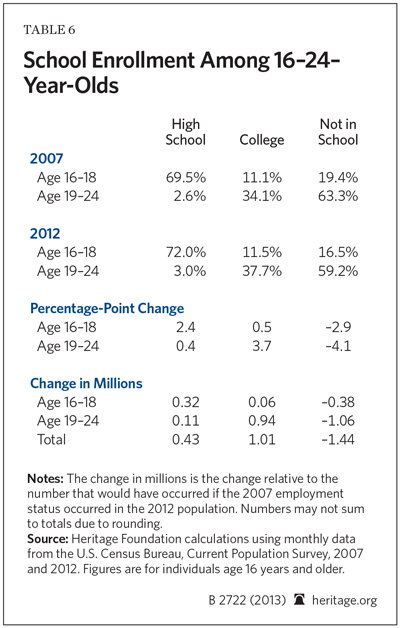
Table 6 shows how school enrollment has inverse, since the recession began, for 16-to-18-year-olds and for 19-to-24-yr-olds. Both loftier schoolhouse and higher enrollment have increased past two to three percent points. Overall, there are 430,000 more young people enrolled in high school, and one,010,000 more young people enrolled in two-twelvemonth and iv-year colleges than if enrollment rates had non increased—1.44 million more students in total. The number of youth in school and not participating in the labor forcefulness has increased by 1.75 million.[twenty] Thus, among younger workers, 4-fifths of the net school-related subtract in labor force participation stems from increased school enrollment. The remaining one-fifth comes from young people who are unable to detect function-time jobs while in schoolhouse.
Different workers who collect disability insurance, students are very probable to render to the labor force when they complete their studies. When they do, they will probably have greater earning potential. The recession has increased the number of people who do non participate in the labor force and who are in school. Even so, as long as these students are gaining valuable skills from their studies, this is unlikely to negatively affect the economy in the long term.
Retirement. Decreasing retirement rates reflect a combination of the long-term shift to 401(k)-style defined-contribution (DC) retirement plans and the weaker economy. Divers-benefit (DB) pension plans provide workers with a stock-still pension upon retirement. Once an employee with a DB pension qualifies for his maximum benefit, he has no fiscal incentive to continue working. His retirement income will not increase. Workers with a 401(k) program, however, have stiff incentives to go on working by their official retirement age. Each actress twelvemonth of work adds to their savings and enables them to accrue a larger nest egg. At the same time, delayed retirement allows workers to filibuster drawing down their savings. The increased use of DC pensions encourages employees to delay retirement.
The recession has amplified that incentive. The stock market has not performed as well as many workers nearing retirement historic period had expected. Although the Due south&P 500 has nominally recovered from its losses in the recession, it has appreciated simply 8 percentage above 2007 levels—less than the rate of inflation during that time.[21] Many older Americans accept delayed retirement in order to accumulate more savings.
Long-term retirement rates will probably keep to fall, fifty-fifty as demographic changes increase the number of retirees. The Congressional Budget Office predicts that the number of workers per Social Security casher will autumn from the electric current three-to-1 ratio to 2-to-one over the adjacent 25 years.[22] Those not participating in the labor force can only consume the wealth produced by those working in information technology. An crumbling population means that older workers will either take to take a lower standard of living in retirement—at that place are fewer workers to back up their consumption—or delay their retirement in social club to accrue larger savings.
Stalled Job Creation
What has acquired the labor market weakness that has both kept unemployment loftier and depressed labor force participation? The immediate answer seems obvious: chore losses. Thousands of companies have gone out of business or downsized, laying off millions of workers and increasing unemployment. While this respond contains a large element of truth, layoffs and task losses are not the principal reason unemployment remains high.
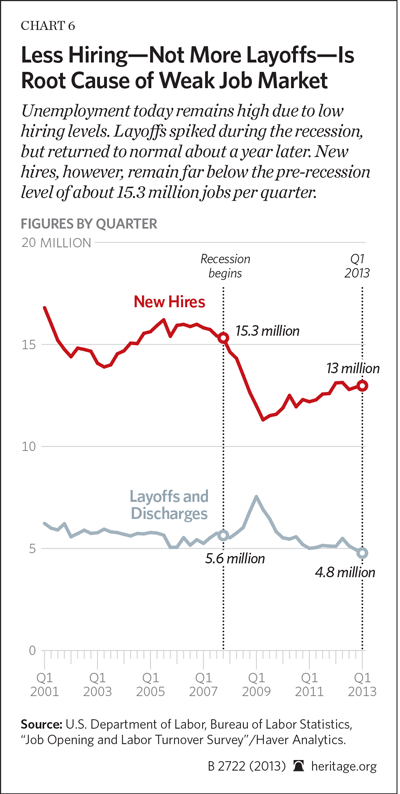
Layoffs surged at the start of the recession, rising from v.6 one thousand thousand in the 4th quarter of 2007 to 7.five million in the first quarter of 2009, a 34 percentage increase.[23] Between 2007 and 2009 16 percent of American workers went through at least i layoff.[24]
Since then, however, layoffs have returned to normal levels. In the start quarter of 2012, employers laid off 4.eight million workers.[25] Employees with jobs today are, in fact, slightly less likely to lose them than they were when the recession began.
Unemployment remains high because new job cosmos dropped when the recession began and has non recovered. Employers hired 13 million new employees in the start quarter of 2013—15 percent fewer than the 15.3 million new workers hired in the concluding quarter of 2007. Unemployment remains high primarily because businesses are creating fewer new jobs—not because of increased layoffs.
Note to Congress
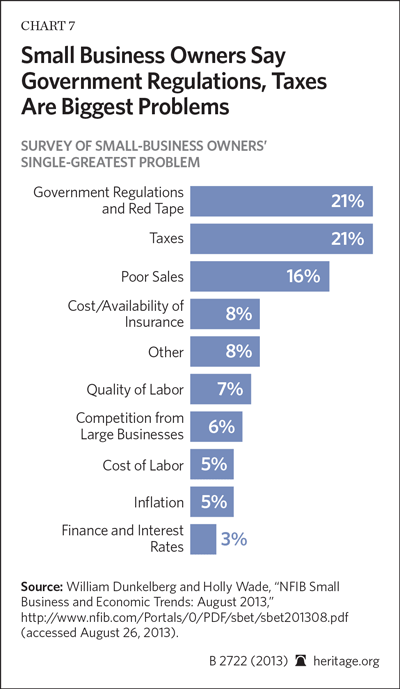
Job creation and new hiring remain depression for several reasons. The well-nigh prominent are the lingering effects of the collapse of the housing chimera and resulting financial crisis, equally well as the domestic consequences of the economic slowdowns in Europe and Communist china. The U.S. authorities has likewise contributed to the problem. Excessive taxes and increased regulation discourage chance-taking and investment. The financial cliff tax hike in January raised the average top marginal tax rate—including federal and state income taxes and payroll taxes—to 48 percent. In high tax states similar California and New York the top tax rate exceeds fifty percent.[26] Entrepreneurs and business owners who accept risks to expand their enterprise get to go on barely half of the additional money they earn, while bearing all the downsides if the venture fails. The Administration has likewise increased the regulatory brunt facing businesses, especially in health care.
Modest-business owners report that tax burden and authorities red tape are significant problems. In fact, pocket-sized-business owners are more likely to cite either taxes (21 percent) or regulations and red tape (21 percentage) as poor sales (16 percent) equally their single greatest trouble.[27]
Congress cannot control Europe'due south economy or retroactively undo the housing bubble. However, Congress does have straight control over the taxes and regulations it imposes on employers. Congress should reform the revenue enhancement code so job creators do not confront tax burdens of almost 50 percent and should streamline or eliminate unnecessary regulations. The government should reduce the brunt on those who are creating jobs during the weakest labor market place in ii generations.
Determination
The economy has barely recovered from the Great Recession. More than than 4 years afterwards the recession started, unemployment remains high. Simply the unemployment rate does not fully measure out the weakness in the economy. Labor force participation has fallen by about two percentage points since the recession began. Some of that decrease is due to demographic factors, primarily the beginning retirements of baby boomers. But such demographics explain simply ane-quarter of the subtract—a weak labor market explains the remaining three-fourths of the drib in labor forcefulness participation.
The workers who have dropped out of the labor force for economical reasons are primarily engaged in one of two activities: collecting disability benefits or studying in school. Many workers have turned to disability benefits for income in the recession. This has increased the number of disability beneficiaries by i.8 million since the recession began. These workers will probably remain permanently exterior the labor forcefulness. Many other potential workers are now exterior the labor force but attending school, partly reflecting the difficulty of finding work: Many students who would similar part-time jobs cannot find them. Others accept decided to enroll in or remain in school during the down economy. Increased high school and higher enrollment rates among 16-to-24-twelvemonth-olds take increased school attendance past 1.4 million.
The labor market remains weak not considering of layoffs—which accept sunk to pre-recession levels—but because job creation and new hiring have fallen. The housing bubble and European economical crisis proceed to concur back the economy, ailments that Congress can do cypher virtually. Congress can do something about the tax and regulatory burden it imposes on businesses. Small-business owners written report that taxes and regulations are as great a problem to them as poor sales. Congress should reform the taxation code and streamline unnecessary and overly burdensome regulations. The weakest labor market in ii generations is no time to make it more difficult for businesses to expand and create jobs.
—James Sherk is Senior Policy Analyst in Labor Economics in the Heart for Information Analysis at The Heritage Foundation. The author is grateful to Heritage Foundation interns Mike Cirrotti and Stephanie Jaczkowski for their assist with this report.
Appendix
Methodology. The master data source for this study was the 2007 and 2012 monthly micro-data from the Electric current Population Survey conducted by the Bureau Labor Statistics in conjunction with the Census Bureau. Variable construction was a large office of the analysis.
Employment condition was measured using a synthetic variable combining two survey responses. One variable (PEMLR) classified respondents as "employed–at piece of work," "employed–absent," "unemployed–on layoff," "unemployed–looking," "not in labor force–retired," "not in labor force–disabled," and "not in labor strength–other." The two employed and unemployed responses were combined to create single "employed" and "unemployed categories." Another variable (PENLFACT) asks people outside the labor force what they are doing: disabled, sick, in school, taking care of home or family, in retirement, or other. The responses to these "not in the labor forcefulness" questions were combined with the responses to PEMLR to create one variable that classified workers under viii different possible employment statuses: (1) employed, (ii) unemployed, (3) non in the labor strength–retired, (iv) not in the labor force–disabled, (5) not in the labor force–sick, (half dozen) not in the labor force–taking care of family, (seven) not in the labor force–at school, and (8) not in the labor force–other. The analysis presented in Tables 1 to 5 uses this constructed variable.
To control for demographic changes, Heritage Foundation analysts divided the population by male and female, by three age categories (16–24, 25–54, and 55+), and by five educational attainment categories (less than a high school degree, high school degree, some college, available's degree, or graduate degree). Workers with an associate's degree were classified equally having "some higher" education. These three groupings produced 2 10 3 ten 5 = 30 possible sexual activity/historic period/pedagogy cells.
To command for demographics and produce Tables 4 and five, Heritage Foundation analysts calculated the employment status of the adult population in 2007 and 2012 in each of these cells, equally well as the proportion of the overall population they represented (i.eastward., women ages 25–54 with some college instruction made up 7.9 percent of the adult population in 2007 and 7.vii pct in 2012). Heritage analysts then constructed a hypothetical 2012 employment status by taking the average of the cell-specific employment statuses in 2012, weighted by the proportion of the overall population in each jail cell in 2007 instead of by the proportion in each cell in 2012 (i.eastward., 7.9 per centum instead of 7.7 percent). This yields a hypothetical employment status for the economy assuming the sex/age/education makeup of the U.S. had not changed in the recession.
Except in the SSA administrative information in Chart 5, the changes in the number of people reported for a given employment status are relative to the number of people that would accept been in that status in 2012 if the labor participation rates had not changed. For case, Tabular array two shows a i.8 million person increment in inability insurance recipients. Current Population Survey information testify that 12.ii million people were on Inability Insurance in 2007 and 14.half dozen one thousand thousand people on Disability Insurance in 2012—a 2.4 meg person increase. However, the adult population besides grew from 231.ix meg to 243.iii one thousand thousand people. This would have increased the number of SSDI recipients fifty-fifty if the charge per unit of SSDI receipt had not changed. The one.8 million figure accounts for this population growth. Information technology shows how many more people are on SSDI at present than would have been the case if SSDI rates had remained at their 2007 level.
Source: https://www.heritage.org/node/11657/print-display
Posted by: villatoroliefalmid1964.blogspot.com
0 Response to "What Is The "Demographic" Makeup Of The Nfib"
Post a Comment